Historical fiction
The human weight of history
I read historical fiction to understand how people lived in their time.
As individuals shaped by the limits, beliefs, and fears of their world. The more precise, the better.
What interests me more is the human weight around the historical event, how choices were made, how values were tested, how everyday life carried meaning even under pressure. However, the books in this section stay dangerously close to history. They are built on documented events, real timelines, and painstaking research. The fiction lives in the margins, in the writer’s imagination between facts, in the human interior that archives can’t record.
When it’s written with care, historical fiction doesn’t recreate the past. It makes it feel close enough to matter.
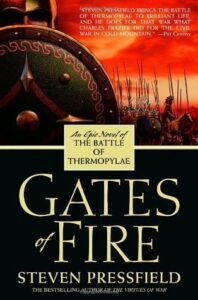
STEVEN PRESSFIELD
Gates of Fire
The Virtues of War
Tides of War
I often think of Pressfield as a modern Homer. He doesn’t imitate the past; he understands it.
What I see in his work is a deep respect for values such as courage, loyalty, and self-sacrifice.
He writes about them without sentimentality, as lived choices rather than ideals.
He has an extraordinary grasp of the psychology of battle and an equally solid command of history.
What he brings to the page is never distorted for the sake of fiction; it feels studied, grounded, and earned.
Gates of Fire is taught at military academies such as West Point, and that says a lot.
And then there is his language. Those spare, almost austere sentences, carrying layers of meaning beneath their surface — precise, restrained, and quietly powerful. I find them unforgettable.
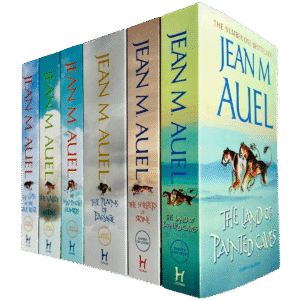
JEAN MARIE AUEL
Earth’s Children series
I still remember the first time I picked up The Clan of the Cave Bear.
I stayed awake until six in the morning to finish it, and I honestly don’t remember how many times I reread it after that, filling the long waiting years until the next book.
What struck me was not only the story but the depth behind it.
Auel’s writing is vivid and immersive, supported by years of painstaking scientific research that brings life thirty thousand years before recorded human history. The Paleolithic age…
Reading the series makes me travel to Ardèche, hoping to see with my own eyes the Chauvet Cave -described so vividly in the last book. Of course, the cave is closed to the public, but I have seen a remarkable replica of the cave at Grotte Chauvet 2 in Ardèche, nearby.
Nothing feels invented for convenience.
The world, the rituals, the survival, the relationships… all of it feels lived-in, earned, and deeply human.
Earth’s Children is not just a historical series. It is an act of reconstruction, one that imagines early humanity with respect, patience, and extraordinary care.
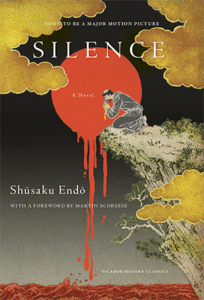
SHŪSAKU ENDŌ
Silence (Chinmoku)
Although I read it in English, I remember the writing as deeply lyrical.
That lyricism runs through all of Endō’s work, shaped by his faith — he was raised Roman Catholic — and it shows.
What struck me most was the way he captures the inner world of the two Catholic priests.
There is one phrase that has never left me: Eloi, Eloi, lama sabachthani… This Aramaic phrase echoes in the mind of the younger priest as he watches the execution of Christians, powerless to intervene.
It is an intense book from beginning to end.
What stays with you is not judgment, but the quiet demand for respect. Respect for another person’s beliefs, even when they are not your own.
This may be something that already defines me, but it was striking to see it emerge so powerfully, without being stated outright, through story alone.
And beyond everything else, Silence opened a nearly unknown chapter of Japanese history for me. One I knew little about before reading it.
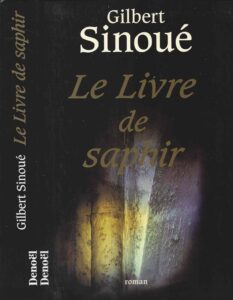
GILBERT SINOUE
Le livre de Saphir
Some books never travel as far as they deserve to.
Not because they lack depth or beauty, but because translation is uneven, selective, and often unfair.
This is one of them.
This book was originally written in French and, unfortunately, has never been translated into English.
I read it in Greek. I lost my original copy years ago and remember searching for it anxiously, trying to replace it, as if something essential had gone missing with it. And it would…
Sinoué’s writing is poetic, deeply reflective, and profoundly human.
The existential dilemmas and religious beliefs that run through the story are intense, pressing quietly but relentlessly on every page.
His words move slowly, thoughtfully, and leave space for doubt rather than certainty.
It feels less like reading a story and more like being asked to sit with questions that have no easy answers.
There are books you admire. And there are books that enter your soul and stay forever. This was one of those.
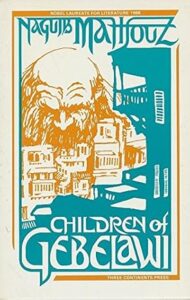
NAQUIB MAHFOUZ
Children of Gebelawi
Cairo Trilogy (Palace Walk, Palace of Desire, Sugar Street)
Through allegory, Mahfouz captures the endless cycle of injustice, betrayal, and sorrow that weighs on the lives of ordinary people.
These stories pass quietly from one generation to the next, carrying wounds that never fully heal.
What makes the novel so powerful is its realism.
Despite its symbolic structure, the world it describes feels painfully true, a close, unflinching look at life in a Cairo neighborhood shaped by hardship and endurance.
As the story unfolds, questions begin to surface through the faith of those who live there: Jews, Christians, and Muslims sharing the same streets, the same suffering.
What does humanity mean to God? Why does this world offer so much pain? Will Grace ever return?
Is God still alive?
It is a gentle, devastating book. Like every single book of this great Egyptian writer.